
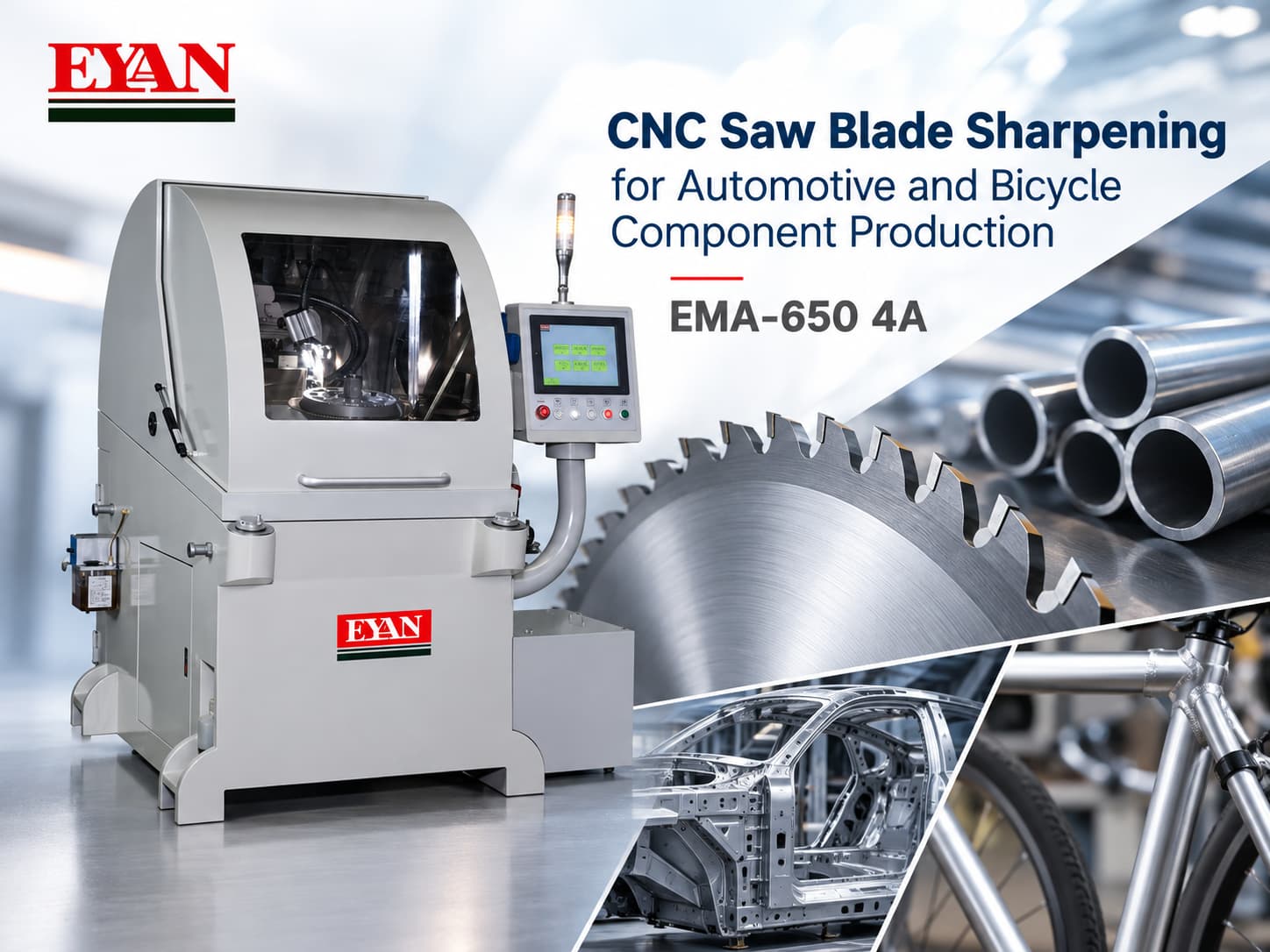
In automotive and bicycle component production, circular saw blades are commonly used to cut metal tubes and other workpieces before machining, forming, welding, or assembly. When the same cutting process is repeated across production batches, maintaining consistent tooth geometry becomes an important part of blade preparation.
Cutting angle, back clearance angle, grinding amount, and chamfer geometry can all affect how consistently a blade performs after sharpening.
For manufacturers handling larger circular saw blades or looking to reduce repeated manual adjustments, the EYAN EMA-650 4A CNC Circular Saw Blade Sharpening Machine combines four-axis CNC control, automatic sharpening, and upper and lower chamfering in one system.
EMA-650 4A at a Glance
Before looking at the sharpening process in detail, here are the key specifications for determining whether the EMA-650 4A matches your blade requirements:
| Key Specification | EMA-650 4A |
|---|---|
| Saw Blade Diameter | Ø100–650 mm |
| Automatic Chamfering Range | Ø170–650 mm |
| Number of Teeth | 10–998 teeth |
| Maximum Blade Thickness | 8 mm |
| Cutting Angle | 0°–30° |
| Grinding Speed | 1–60 teeth/min |
| CNC Control | 4-axis servo control |
| Controlled Axes | X, Z, B, Y |
| Chamfering | Automatic upper & lower chamfering |
The EMA-650 4A is designed for manufacturers and sharpening operations that need to handle different circular saw blade sizes while maintaining repeatable grinding parameters through CNC control.
Need to Confirm Whether the EMA-650 4A Can Handle Your Saw Blade?
Tell EYAN your blade diameter, thickness, number of teeth, material, and sharpening requirements. Our team can help you evaluate the appropriate sharpening solution.
Why Saw Blade Sharpening Matters in Automotive and Bicycle Component Production
Automotive and bicycle production involves a wide range of metal cutting requirements. Depending on the application, manufacturers may need to process metal tubes, aluminum tubes, structural components, and other workpieces before subsequent manufacturing stages.
The condition of the circular saw blade can therefore influence more than the cutting operation itself.
Four grinding parameters are particularly important:
- Cutting angle: Determines the geometry of the cutting edge as it engages the workpiece.
- Back clearance angle: Provides clearance behind the cutting edge.
- Grinding amount: Determines how much material is removed during resharpening.
- Chamfer consistency: Helps maintain uniform tooth preparation around the blade.
When these settings depend heavily on repeated manual adjustment, reproducing the same sharpening condition across multiple blades can become more difficult.
From Cutting Quality to Downstream Processing
A circular saw blade should not only be sharp. Its tooth geometry should also remain consistent throughout the blade.
Variations in grinding geometry can contribute to differences in cutting behavior from tooth to tooth. For manufacturers processing components in batches, inconsistent blade preparation may make it more difficult to maintain stable cutting conditions.
This becomes particularly relevant when the cut workpiece will continue into subsequent processes such as machining, forming, welding, or assembly.
A repeatable CNC saw blade sharpening process helps manufacturers control the condition of the cutting tool before it returns to production.
Why Four-Axis CNC Control Matters
The EMA-650 4A uses AC servomotors on the X, Z, B, and Y axes, allowing major sharpening parameters to be managed through the CNC system.
Operators can set parameters including:
- Saw blade diameter
- Number of teeth
- Grinding amount
- Cutting angle
- Back clearance angle
- Upper and lower chamfering
Instead of repeatedly relying on manual calculations and mechanical adjustments, the required parameters can be entered into the control system for automated operation.
This is especially useful when manufacturers need to sharpen multiple blades or reproduce established sharpening conditions for recurring production jobs.
Automatic Sharpening and Upper & Lower Chamfering
One of the key features of the EMA-650 4A CNC circular saw blade sharpening machine is the integration of sharpening and chamfering.
The machine provides an automatic chamfering range from Ø170 to Ø650 mm and performs both upper and lower chamfering.
Bringing these operations into a CNC-controlled process helps reduce the number of separate manual adjustments required during blade preparation.
For manufacturers that regularly use HSS saw blades or other circular metal cutting saw blades requiring consistent tooth preparation, this makes the sharpening workflow easier to standardize.
Why the Ø650 mm Capacity Matters
The EMA-650 4A can sharpen circular saw blades from Ø100 to Ø650 mm, making blade capacity one of the first specifications manufacturers should consider when evaluating the machine.
A wider diameter range is useful when a production facility or sharpening operation handles different saw blade sizes rather than working with only one diameter.
The machine also supports:
- 10–998 teeth
- Blade thickness up to 8 mm
- Cutting angles from 0° to 30°
- Grinding speeds from 1 to 60 teeth per minute
Together, these specifications allow the EMA-650 4A to cover a broad range of circular saw blade sharpening requirements.
Reducing Dependence on Repeated Manual Adjustment
Experienced operators remain important in saw blade sharpening, particularly when determining the correct geometry for a specific blade and cutting application.
However, once the required sharpening parameters have been established, repeatedly reproducing those settings manually can add unnecessary variation and setup work.
The EMA-650 4A addresses this by using CNC control to automate key movements and sharpening parameters.
For manufacturers, the benefit is not simply "automation." It is the ability to establish a more repeatable blade preparation process across recurring sharpening jobs.
Is the EMA-650 4A Right for Your Saw Blades?
The EYAN EMA-650 4A is worth considering if you are looking for:
- CNC saw blade sharpening with four-axis servo control
- A circular saw blade sharpening machine for blades up to Ø650 mm
- Automatic upper and lower chamfering
- Controlled cutting and back clearance angles
- Sharpening for blades with 10–998 teeth
- A solution for HSS and circular metal cutting saw blades
- Less repetitive manual adjustment during sharpening
- More repeatable sharpening parameters across production batches
For automotive component cutting, bicycle tube cutting, and other metal cutting applications, choosing the right sharpening system starts with the saw blade itself.
Have a Specific Blade You Need to Sharpen?
Send EYAN your blade diameter, thickness, number of teeth, blade material, and current sharpening requirements. We can help you determine whether the EMA-650 4A CNC Circular Saw Blade Sharpening Machine is suitable for your application.
Explore the machine specifications and features: